Showing posts with label David Byrne. Show all posts

Thursday, October 24, 2013

David Byrne, Spotify and the Art in the Digital Age

David, I apologize for this rant in advance
I had a blog entry planned this week. I was going to write an extremely snarky, sarcastic review of the Metallica, Lou Reed collaborative album Lulu; a record so bad that it was "terrifying". And while I may do that at some point in the future, I'm going to take a break from my Halloween stuff in order to write about something a little more timely and relevant.

David Byrne, former frontman of the Talking Heads and indisputable genius in his own right, wrote an op-ed in the UK paper "The Guardian" a couple of weeks ago. In it, he decried the internet streaming service Spotify. Byrne makes a number of claims in his piece. He argues that Spoitfy and services like it will eventually own the entire market, and that digital streaming will supplant record sales. He goes on to speculate that while established acts like his own will survive, up and coming acts will be squeezed out of the market. His opinion reflects that of many others, including Radiohead frontman Thom Yorke.

Destroyer of worlds. Or at least the arts, apparently.

Now, I love David Byrne. He's probably my favorite artist recording music today. So it is with the utmost respect that I insist that, while some of Byrne's points are valid ones, most of what he's saying here is simply not accurate.

First, I should acknowledge that Byrne isn't entirely in the wrong here. Spotify royalties to the artists are a pittance. He correctly points out at one point that an artist would need to have his music streamed over 230,000,000 times just to make an even $15,000, minimum wage salary. There's some validity to that criticism. I, for one, would gladly accept an increase in Spotify's monthly fee if meant that artists received more money for their work.

And I'm not alone in that, which is precisely the problem with his logic. Byrne, and others like him who have railed against the digital music revolution, fundamentally misunderstand their own fanbase. The assumption fans would rather take music for free than pay artists for it is one that flies in the face of a number of success stories that the internet has produced. The Scottish electronic band Chvrches released their debut hit "Lies" for free on the Neon Gold blog, and saw explosive popularity thereafter. When they released their debut album, they streamed it for free on NPR, a number of music sites and Spotify, and the record still sold a chart topping 16,000 copies it's first week. People bought it because they liked their music and wanted to support the artist. Despite the fact that the music was widely available for free, people bought it anyway simply because they wanted to own it for themselves.
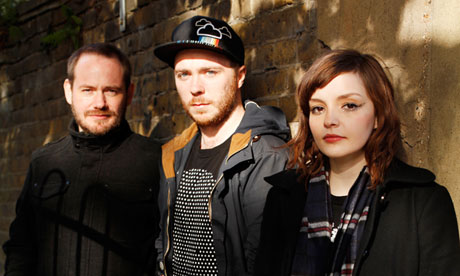
The picture of "internet success"

Take this argument to its logical extreme, and you find Kickstarter. Dozens of artists have used the site as a launch point for albums. And while it's mostly going to local, "small time" acts, there are also groups like Toad the Wet Sprocket, who just raised $260,000 on a $50,000 goal to cover the production costs of a new record. In other words, the group's fans wanted new music from them so badly that they laid down five times the money that was asked of them for a record  that didn't even exist yet. And the real kicker is that those who donated are still going to buy the finished product, despite the fact that they funded its very existence. In any other business venture, such an investment ahead of the product would warrant the sharing of profits among the investors. But fans of music, games, film and other Kickstarter ventures invest that money simply because they want a chance to purchase the product.

I'm generally loathe to throw out anecdotal evidence to make a case. But these individual stories represent a broader trend. Primarily on the backs of digital media outlets like Amazon and Itunes, the music industry last year saw its first increase in record sales since 1999. And on top of that, there was a decrease in piracy. Granted, $16 billion is a far cry from the industry's $28 billion high, but the increase is a reflection in modern trends that defies the argument of digital deniers: despite an explosion in free or cheap online streaming resources and an abundance of illegal options, more people are buying music than they did last year. Spotify itself, which has 6 million paying customers as of May, is a testament to the fact that. Despite having free services like Youtube at their disposal, fans are more than happy to fork over money for the music they love.

Perhaps even more baffling than artists like Byrne blaming fans for not supporting the music, is that they're making Spotify out to be the culprit at all. Spotify is not the reason artists barely receive any pay for the songs they play. The company has already doled out over 70% of its revenue for royalties alone. No, they're not the bad guy here; it's with the labels that they're paying the royalties out to. Just as they did with radio royalties before, labels take the lion's share of the money fronted by Spotify (which, for the record, is to the tune of a half billion dollars), and then give a pittance of that back to the artists themselves. The problem that exists in the current music market is the problem that's always existed: labels are an outdated form of distribution. It's not the fans who robbed David Byrne, and it's not even Spotify. It's the same middleman that has artificially inflated the price of music for decades. That these artists can't see that is strange, considering how long it's gone on.

Y'know...guys like this
Consumers have always wanted more flexible musical options. It's why they recorded singles from the radio on cassette, instead of buying albums loaded with filler. It's why they turned to illegal downloading. The hunger that's existed in fans for affordable means of building a music collection stems from the record labels that put a stranglehold on music distribution. Spotify didn't create that need. They're a response to it. And thanks to their success and that of other digital distribution, music piracy has been on the decline for years. In fact, there's even a great deal of evidence to suggest that Spotify is acting as a boon to Itunes purchases. Services like Spotify aren't supplanting music purchases; they're informing them.

It has been high time for a long time that the old model of music distribution was abandoned. Record labels for years have been in the business of exploiting both consumers and artists. Byrne, of all people, should know that. Ironically, by pulling out of Spotify and other services like it, artists are cutting off what may well be the best hope for a change in the industry. And it's the emerging artists that Byrne fears for that have the most to gain from that transition. The great contribution of the internet to the arts has been the way that digitization has broken down the barriers between content creators and their consumers. And with all due respect to Mr. Byrne, that anyone would try to destroy that newborn intimacy shocks me. Change is coming, whether those used to the old business model like it or not. And I for one welcome it.

Thursday, June 13, 2013

Golden Jukebox: Life is Long by David Byrne & Brian Eno

This is my first Golden Jukebox entry. Think of it as a playlist of nothing but my favorite songs. Here you'll find exactly what you'd expect: the song and why it means so much to me. I chose thing one in particular to create a contrast with my entry the other day. Where Murder Ballads is a dark, sorrowful record, Life is Long is about as uplifting as music gets.


If you intend to read this blog with any sort of regularity, you are going to hear a lot about David Byrne. Whether it's his work in the Talking Heads, his solo material or collaborations with any one of the numerous artists he's recorded with over the years, the man has proven himself to be a genius time and time again. Speaking in terms of personal tastes, he's my favorite artist still recording today, and there is very little of his material that I don't cherish in one way or another.

Back in August of 2008, he recorded the album Everything that Happens will Happen Today with composer Brian Eno (There second collaboration, after 1981's My Life in a Bush of Ghosts). At the time, Byrne lived in America and his hand was very much on its pulse. Ongoing wars, a divisive election, a looming economic meltdown (which would come to its head mere weeks after the album's release) and a general dissatisfaction with the state of affairs is what he saw. In response, he and Eno set out to write what they like to describe as an "electronic gospel" record. They meant to deliver a hopeful, uplifting record for the troubled times.

And did they ever.

Everything That Happens Will Happen Today is a beautiful record that touts the healing that people can find in one another. And although it's not the title track, Life is Long embodies the spirit of the album more than any other. The opening lines, in particular, sum it up best.

"Everybody says that the living is easy
I can barely see, 'cause my head's in the way
Tigers walk behind me
They are to remind me
That I'm lost, but I'm not afraid"

In itself, the opening of the song is a brilliant statement of hope. It's too often true that the one thing keeping us from happiness is the meddling of our own minds. And even though the way forward might not be clear, the right frame of mind can allow us to face it bravely and content ourselves with our blessings. The "chains and bars" that Byrne sings of are the worldly obstacles that life places in our paths, but in spite of them, freedom can remain in heart if one chooses simply to share life with others. Toward the end of the track, during one of the "refrains", Byrne describes the ability to say "those three little words" as being enough to hold back the troubled water around him. The theme (essentially love conquers all) is hardly a new one, but it's stated in a more elegant, honest way than many have been able to. Love in others isn't simply all you need, as the Beatles might have you believe, but it is enough to sustain one's personal wellness. It's enough to lengthen and strengthen life beyond what it can appear at face value. And it can certainly help ward off the dread that can seep in when the world throws its inevitable curve-balls.

 It's a comforting message, and Byrne's vocals sell it beautifully. Never in his career has he sounded better, or more earnest than he does in this song. Typically known for being flat, pitched and minimalist (particularly in his performances with the Talking Heads), he really opens up on this record to pour his heart out. It lends an emotional reverence to this song in particular, and helps drive home the meaning of his words. I believe that  he's dreaming a world, because he sounds so passionate about it. I believe that he's still free because of the elation in his voice. Byrne isn't given enough credit for his vocal range, and while this is not a traditional gospel recording by any means, he delivers it with all the enthusiasm of a reverend singing with his flock.

Of course, the lyrics and vocals are doing half of the work in this song. Backing them up is Brian Eno's brilliant composition. As is typical Eno, it's occasionally difficult to discern exactly what instrument you're hearing at any given time. But despite the obfuscation of sounds, they all come together in an uplifting, ethereal cacophony. This is big, harmonic, powerful cathedral-style gospel music with a modern twist that only a mind like Eno could have concocted. The way he layers Byrne's vocals on the refrain creates an almost choral echo that compliments the lyrics' message of the power in human oneness.

I often (lovingly) joke that David Byrne is a space alien. In much of his body of work, he seems almost like a fascinated outsider looking in at the curious interactions that man-things have with one another. But in this song, he displays an understanding of love's power to lift us above life's hurdles that can only, truly be expressed by someone who's experienced it for himself. The world is hard on us sometimes. Jobs disappear, money grows scarce, people get sick and friends drift away. All of these things have happened to each of us at one point or another, but we keep on going because we know it gets better. And it gets better because, at the end of the day, the best thing people have going for them is that we can connect with other people. We share our lives, grow close and come to depend on one another. Life is Long celebrates that bond we all share, and does it well. That's why it will always be one of my favorites.